Global Harmonisation of GMP Standards: Navigating Differences Between FDA, EMA, and PIC/S
Global pharmaceutical manufacturing operates across multiple regulatory frameworks. While core Good Manufacturing Practice (GMP) principles are convergent, there are meaningful differences in structure, terminology, annex coverage and enforcement between the FDA Code of Federal Regulations 21 CFR Parts 210/211, the EU’s EudraLex Volume 4, and Pharmaceutical Inspection/Cooperation Scheme’s PIC/S PE 009-17. This blog details key differences – particularly across the annexes – and sets out an actionable alignment plan for organisations manufacturing across jurisdictions, taking practical steps toward achieving Global Harmonisation of GMP Standards.
Regulatory Baselines and Current Status
- FDA (United States): The binding current GMP (CGMP) regulations for finished pharmaceuticals are 21 CFR Parts 210 and 211. FDA guidance documents then provide further interpretation on the expectations of these CFRs
- EU GMP (EudraLex Volume 4): A guideline-based system structured by Chapters and Annexes for human and veterinary products.
- Annex 1 (sterile manufacture) was comprehensively revised in 2022 with implementation dates in 2023/2024, and Annex 21 (Importation) entered into force in August 2022.
- Drafts to update Annex 11 (Computerised Systems), Chapter 4 (Documentation) and a new Annex 22 (Artificial Intelligence) were released for consultation in July 2025.
- PIC/S PE 009-17 (2023): A widely adopted GMP guide, predominantly harmonised with EU GMP, including Annexes 1–20 and adoption of EU Annex 16 principles as “Authorised Person and batch release”.
- Many regulators adopt PE 009-17 with local transitions. In Australia, the TGA formally moved from PE 009-16 to PE 009-17 on 1 September 2025, focusing changes on Annex 1.
Structural Differences and Annex-by-Annex Comparison
At a high level, FDA relies on legally binding regulations and guidance, whereas EU GMP and PIC/S provides a guideline framework with detailed Annexes. The table below highlights practical differences relevant to multinational operations.
|
EU GMP (EudraLex Vol. 4) |
PIC/S PE 009-17 |
FDA (21 CFR / Guidance) |
|
|---|---|---|---|
|
Sterile products |
Annex 1: Contamination control, barrier technologies, grade A continuous particle monitoring, aseptic process simulation, single-use systems, detailed sections & timelines. |
Annex 1 mirrored in PE 009-17 with same contamination control and technology focus. |
Regulation via 21 CFR 210/211; Guidance: Aseptic Processing detailing ISO classifications, environmental monitoring, airflow studies. |
|
Biological Medicines |
Annex 2 Manufacture of Biological Medicinal Products |
Split into 2A (Advanced Therapy Medicinal Products) and 2B (Biologicals) |
21 CFR Parts 600 –601 and 610-680 apply, focusing on licencing and safety |
|
Computerised systems & data integrity |
Annex 11, 2011, and the new 2025 draft which expands lifecycle, security, access, audit trails; Chapter 4 draft strengthens documentation/data lifecycle; new Annex 22 (AI) is in consultation. |
Annex 11 aligned to EU GMP; PIC/S PI 041 provides data integrity expectations for inspectors/manufacturers. |
21 CFR Part 11 applies to electronic records/signatures; FDA Data Integrity guidance clarifies expectations. |
|
Qualification & validation |
Annex 15: lifecycle qualification/validation, continued process validation (CPV) recognised; cleaning validation & risk-based approaches. |
Annex 15 aligned within PE 009-17; same lifecycle emphasis. |
Process Validation Guidance (2011): lifecycle approach (Stages 1–3), statistical controls and CPV. |
|
Batch release role |
Annex 16: Qualified Person (QP) certification and batch release; import retesting rules; reliance on marketing/clinical trial authorisation. |
Adopts Annex 16 principles with “Authorised Person” terminology; import elements voluntary per national law. |
No QP; Quality Unit responsibilities in Part 211; release is conducted per firm’s procedures under CGMP. |
|
Importation specifics |
Annex 21 (2022): MIA holder obligations; site of physical import; QP certification only after customs clearance; MRAs may waive testing. |
No standalone import annex; relies on Annex 16 and national law |
MRA with EU (2017; expanded to veterinary 2023) enables reliance/waivers; FDA/US import testing not governed by an “annex”. |
Mutual Recognition Agreements (MRAs) and cross-border supply chains
An MRA is a formal agreement between two or more regulatory authorities to mutually recognise each other’s inspection outcomes, certifications, or conformity assessments for specific regulated products, for example allowing one authority to rely on the GMP inspection and certification performed by another.
MRAs reduce the need for duplicative inspections and can facilitate international trade and waive batch re-testing on import when scope permits (e.g., EU–US MRA human medicines since 2017). Australia utilises MRAs with the EU, UK, Canada, Singapore, New Zealand, and uses other cooperation arrangements that facilitate GMP clearance.
Practical implication:
Where an EU QP certifies a batch post-import under Annex 21, you should confirm whether MRA conditions waive confirmatory testing; otherwise ensure EU retesting and full documentation access at the QP certification site.
Scenarios: Manufacturing Across Jurisdictions
Scenario A – API manufacture in India, fill–finish in US, EU import via Germany, Australian distribution:
- The API site follows PIC/S Part II and local GMP
- The US site releases under FDA CGMP
- EU import triggers Annex 21 obligations and QP certification post-customs.
If an EU–US MRA covers the site, EU retesting may be waived. Australia relies on MRAs and GMP clearance pathways to recognise inspections.
Scenario B – EU biologic manufacture, secondary packaging in UK, export to Australia:
- EU QP certifies primary lot per Annex 16 QP Certification
- UK operations follow UK/EU-aligned GMP with MRA arrangements
- Australia accepts evidence via EU/UK MRAs and PIC/S membership through GMP Clearance.
Strategies to Ensure Alignment with Regulatory Requirements
Ensuring alignment and compliance across regulatory borders is challenging. A robust and methodical approach will best place you to ensure compliance:
- Adopt ICH Q8–Q10 and Q9(R1) as the common language across sites; embed QRM and lifecycle validation as the baseline.
- Create global procedures with local addenda mapping to EU Annexes (1, 11, 15, 16, 21), FDA Part 211/11, and PIC/S PE 009-17.
- Use Technology for Harmonisation: Implement Electronic Quality Management Systems (eQMS) with role-based access, audit trails, and Part 11/Annex 11 controls; prepare for upcoming regulatory changes.
- Establish QP/Authorised Person oversight and release pathways with documentation access at the EU certification site; define responsibilities in quality agreements (Chapter 7).
- Build an importation playbook (EU Annex 21): define the site of physical import, customs clearance steps, QP certification sequencing, and whether MRAs will waive confirmatory testing.
- Run a cross-jurisdiction validation programme: FDA lifecycle (Stages 1–3) is aligned with EU Annex 15 and CPV; include data integrity controls from PIC/S PI 041 and FDA data integrity guidance.
- Maintain a regulatory watch process for upcoming changes. e.g. currently, Chapter 4, Annex 11 and 22 drafts, and national adoptions (e.g., TGA’s transition to the next PIC/S version).
- Implement Robust Training Programs: Ensure staff understand both global principles and local regulations.
Regulatory Global Harmonisation Initiatives
PIC/S plays a key role in harmonising GMP standards globally. Its guidance documents often bridge gaps between FDA and EMA expectations. Additionally:
- Mutual Recognition Agreements (MRAs) between regions reduce duplicate inspections.
- WHO GMP guidelines provide a baseline for emerging markets.
Global harmonisation is not just about aligning written standards—it involves cultural, operational, and technological integration. For example, while FDA inspections often focus on data integrity and electronic systems compliance, EMA inspectors may place greater emphasis on risk management documentation and Annex-specific requirements. PIC/S, on the other hand, acts as a bridge, promoting best practices and training programs that help inspectors apply consistent principles worldwide.
Challenges of Regulatory Global Harmonisation for Multinational Manufacturers
Multinational manufacturers face several challenges when pursuing global harmonisation of regulatory standards, requiring them to navigate multiple inspection regimes, each with its own requirements and expectations.
Each regime must be appropriately documented in aligned standard operating procedures (SOPs) – preparing such documentation to satisfy all relevant authorities can be complex and time-consuming.
Additionally, manufacturers need to manage cultural and operational differences across various sites, which can impact the consistency of compliance efforts.
The process often results in increased costs and greater complexity, making regulatory compliance more demanding and higher risk for organisations operating in multiple jurisdictions.
Emerging Trends Driving Global Harmonisation
Digitalisation is accelerating harmonisation efforts. Cloud-based QMS allow multinational companies to maintain a single source of truth for SOPs, training records, and validation documentation. Blockchain technology is also gaining traction for secure, tamper-proof audit trails, which can satisfy multiple regulatory authorities simultaneously.
Data integrity remains a universal priority. Regulators across regions are increasingly aligned on expectations for electronic records, audit trails, and cybersecurity measures. Manufacturers should anticipate stricter enforcement of these principles and invest in technologies that support compliance globally.
Data Integrity & Computerised Systems: Actionable Controls
To ensure compliance to data integrity requirements is maintained, consider your alignment of Annex 11/Part 11 controls e.g. validated applications, qualified infrastructure, role-based access, unique credentials, audit trails, electronic signatures, periodic review, backup/archiving.
Where AI-enabled systems are used, consider your governance per the 2025 Annex 22 draft consultation (model validation, training data, performance monitoring, human-in-the-loop) in readiness for adoption.
Implementation Roadmap of Global Harmonisation
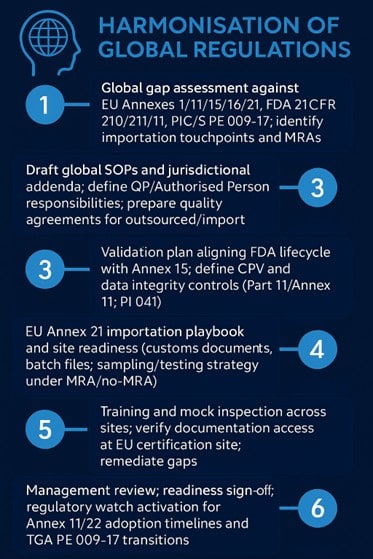
Implementing Global SOPs
One challenge in harmonisation is balancing global consistency with local flexibility. A practical approach is to create tiered SOPs:
- Global SOPs: Define overarching principles and processes aligned with ICH guidelines.
- Regional Addenda: Address jurisdiction-specific requirements, such as EMA Annexes or FDA CFR references.
- Site-Level Work Instructions: Translate global and regional requirements into actionable steps for operators.
This structure ensures compliance while accommodating local nuances. Implementation must be clear, consistent and careful, ensuring personnel at local sites are correctly trained to meet their local regulatory requirements
The Role of Training and Culture
Harmonisation is not purely technical—it requires cultural alignment and nuanced understanding. Training programs should emphasise why harmonisation matters, linking it to patient safety and operational efficiency. Cross-functional workshops and global quality forums can foster collaboration and shared understanding.
Future Outlook
We should expect continued convergence of GMP standards through ICH initiatives and PIC/S expansion. Digitalisation and data integrity will remain focal points, requiring global strategies for compliance, with greater reliance on digital tools, predictive analytics, and AI-driven compliance monitoring. These technologies will enable real-time visibility across global operations, reducing the risk of non-compliance and supporting continuous improvement.
Global harmonisation of GMP standards is essential for efficient, compliant operations in a multinational environment. By leveraging ICH guidelines, adopting risk-based approaches, and investing in harmonised systems, manufacturers can reduce complexity and ensure consistent quality worldwide
PharmOut Services
PharmOut helps manufacturers navigate global GMP requirements through:
- Gap analysis and harmonisation planning.
- Development of global SOPs and quality systems.
- Training on international GMP standards.
- Validation and compliance support across jurisdictions.
Explore our GMP training courses at onlinegmptraining.com for practical insights, or contact us via the website or via email for assistance.
Frequently Asked Questions (FAQs)
PIC/S PE 009-17 annexes largely mirror EU GMP Annexes. Notable points: Annex 2 split into 2A (ATMPs) and 2B (biologicals); Annex 16 adopted in PIC/S using ‘Authorised Person’ terminology; EU uniquely adds Annex 21 for importation.
In the EU/EEA, Annex 16 requires QP certification before release or export; PIC/S mirrors this via Authorised Person where it is adopted by national law; the US has no QP concept—release is under CGMP with a Quality Unit.
Under MRAs (e.g., EU–US), re-testing may be waived subject to scope and capability assessments; otherwise Annex 21 and 16 require testing and full documentation at the certification site.
The EU published drafts in July 2025 for Annex 11 (expanded controls), Chapter 4 (data lifecycle), and Annex 22 (AI). Prepare governance, cybersecurity and validation updates ahead of expected mid-2026 adoption. citeturn1search27turn1search31
Australia transitioned from PE 009-16 to PE 009-17 on 1 September 2025 focus on Annex 1 steriles. MRAs and GMP Clearance mechanisms support reliance on overseas inspections.
Key references
- EMA Annex 11, Annex 22, Chapter 4 Drafts (2025)
- EMA MRAs overview (Australia; US)
- EU Annex 15 (Qualification & Validation
- EU Annex 16 (QP Certification)
- EU GMP Annex 1 (2022 revision)
- EU GMP Annex 11 (2011)
- EU GMP Annex 21 (Importation)
- FDA 21 CFR Part 210 (eCFR)
- FDA 21 CFR Part 211 (eCFR)
- FDA Guidance: Aseptic Processing (2004)
- FDA Guidance: Process Validation (2011)
- Final Annex 21 publication note
- ICH Q8 Pharmaceutical Development
- ICH Q9 Quality Risk Management
- ICH Q10 Pharmaceutical Quality System
- PIC/S data integrity (PI 041)
- PIC/S PE 009-17 Annexes list
- TGA adoption of PE 009-17 (2025)
- TGA guidance page PE 009-17 (2025)
- TGA international agreements for GMP clearance
- US–EU MRA FAQs (FDA)
- WHO GMPs