Advanced Visual Inspection Technologies: AI and Machine Learning for Defect Detection
Visual inspection is a critical step in pharmaceutical manufacturing, ensuring that injectable products and other dosage forms meet stringent quality standards. Traditionally, this process has relied on human operators, but advances in Artificial Intelligence (AI) and Machine Learning (ML) are transforming inspection practices. Comparing manual and automated inspection methods, we’ll explore AI-driven defect detection and examine regulatory acceptance of these technologies.
Manual vs Automated Inspection
Manual inspection has been the industry standard for decades. Operators visually examine products for defects such as particulate matter, cracks, or discoloration. While effective, manual inspection has limitations:
- Subjectivity and variability between operators.
- Fatigue and reduced accuracy over time.
- Limited scalability for high-volume production.
Automated inspection systems address these challenges by using cameras, sensors, and algorithms to detect defects consistently and at high speed. Benefits include:
- Increased throughput and efficiency.
- Objective, repeatable results.
- Integration with data analytics for trend monitoring.
However, automated systems require significant investment and continued validation to ensure reliability.
AI and Machine Learning in Defect Detection
AI and ML enhance automated inspection by enabling systems to learn from data and improve over time. Applications include:
- Image Recognition: Algorithms trained on thousands of defect images can identify subtle anomalies.
- Predictive Analytics: ML models predict defect trends, allowing pre-emptive interventions.
- Adaptive Systems: AI adjusts inspection parameters based on real-time feedback.
A sterile injectable manufacturer implemented an AI-based system that reduced false rejects by 40% and improved detection of micro-defects previously missed by manual inspection.
Regulatory Acceptance of AI-Based Systems
Regulators recognise the potential of AI but require compliance with GMP principles. Manufacturers must:
- Validation: Demonstrate that AI systems consistently meet predefined acceptance criteria.
- Transparency: Provide explainable AI outputs to justify decisions.
- Data Integrity: Maintain audit trails for all algorithm updates and inspection results.
References
- EMA’s Annex 11 for Computerised Systems (draft update)
- EMA’s Annex 22 for Artificial Intelligence (draft)
- FDA’s Guidance on Data Integrity and Compliance with CGMP.
- PIC/S PI 041 on Data Integrity.
- IPSE GAMP 5 principles for automated systems
Validation Strategies for AI Systems
Effective validation of AI-powered automated inspection systems is essential to ensure regulatory compliance, product quality, and patient safety. Beyond initial qualification, a robust validation strategy should encompass the entire lifecycle of the AI solution, from design and deployment to ongoing monitoring and improvement.
Comprehensive Risk Assessment:
Begin by mapping out the intended use of the AI system and identifying potential risks associated with misclassification, data drift, or algorithmic bias. This assessment should inform the design of challenge tests and acceptance criteria, ensuring that the system’s performance is evaluated under realistic operating conditions.
Data Integrity and Traceability:
Maintain rigorous documentation of all data sources used for algorithm training, validation, and retraining. Implement audit trails for every model update, ensuring traceability and transparency. This is critical for regulatory inspections and supports the principles outlined in EMA Annex 11, Annex 22, and FDA guidance.
Explainability and Transparency:
Regulators increasingly expect AI systems to provide explainable outputs. Incorporate tools and processes that allow users to interpret model decisions, especially in cases of defect detection. This not only facilitates regulatory review but also builds trust among operators and quality teams.
Periodic Revalidation and Performance Monitoring:
AI models can evolve over time as new data becomes available. Establish protocols for periodic revalidation, including routine challenge testing with fresh defect samples and monitoring for performance drift. Automated alerts and dashboards can help flag anomalies, prompting timely interventions.
Cross-functional Collaboration:
Engage stakeholders from quality assurance, IT, and operations throughout the validation process. Collaborative validation ensures that technical, regulatory, and operational requirements are harmonised, reducing the risk of oversight and facilitating smoother implementation.
By adopting these strategies, manufacturers can demonstrate robust control over AI-driven inspection systems, satisfy regulatory expectations, and continually optimise defect detection performance.
PharmOut recommends adopting a lifecycle approach, including periodic revalidation after model updates.
Benefits and Limitations
|
Benefits: |
Limitations: |
|---|---|
|
Enhanced detection accuracy and consistency. |
High initial investment. |
|
Reduced human error and operational costs. |
Complexity in validation and regulatory approval. |
|
Real-time data for continuous improvement. |
Need for skilled personnel to manage AI systems. |
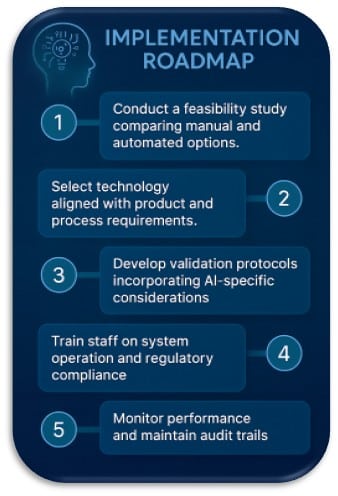
Practical Implementation Roadmap
Future Outlook
AI and ML will continue to advance, enabling real-time defect detection and integration with Pharma 4.0 initiatives. Expect greater regulatory guidance and adoption of explainable AI to enhance transparency.
AI and ML are revolutionising visual inspection, offering improved accuracy, efficiency, and compliance. By adopting these technologies responsibly, manufacturers can enhance product quality and meet evolving regulatory expectations.
PharmOut Services
PharmOut supports manufacturers in implementing advanced visual inspection technologies. Our services include:
- Technology selection and feasibility studies.
- Validation planning and execution for AI-based systems.
- Staff training on GMP and automated inspection compliance.
Explore our GMP training courses at onlinegmptraining.com for practical insights, or contact us via the website or via email for assistance.
Frequently Asked Questions (FAQ)
Manual inspection relies on human operators to visually detect defects, which can introduce subjectivity and variability. Automated inspection uses cameras, sensors, and AI algorithms for consistent, high-speed defect detection, improving accuracy and scalability.
AI and machine learning algorithms are trained on large datasets of defect images, enabling systems to identify subtle anomalies, predict defect trends, and adapt inspection parameters in real time. This leads to reduced false rejects and improved detection of micro-defects.
Yes, provided they are validated according to Good Manufacturing Practice (GMP) principles. Regulators require manufacturers to demonstrate consistent performance, maintain data integrity, and provide explainable AI outputs for decision justification.
Validation involves defining intended use, risk assessment, setting acceptance criteria, performing challenge testing with known defect samples, and documenting algorithm training and retraining protocols. Periodic revalidation is recommended after model updates.
Challenges include high initial investment, complexity in validation and regulatory approval, and the need for skilled personnel to manage and maintain AI systems.
PharmOut offers consulting services for technology selection, feasibility studies, validation planning and execution, and staff training on GMP and automated inspection compliance.